Topeka
A Boy and His DogTopeka is an underground settlement presented first as a nearby, quiet town and then experienced by Vic as a sealed world of artificial order. Its decisive significance lies in the contradiction built into its design: it offers houses, streets, lawns, shops, and communal routines beneath the earth, yet its protection depends on confinement, surveillance, regulated behavior, and the exclusion of outsiders. Vic’s visit turns Topeka from a seemingly attractive refuge into the clearest image of a life preserved at the cost of freedom.
Location and Physical Design
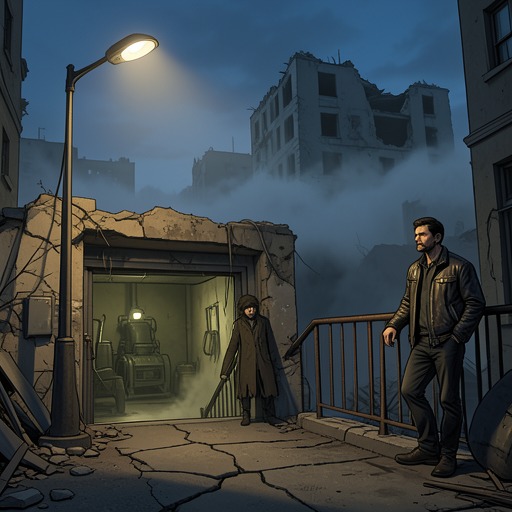
Topeka lies in a downunder reached through an access dropshaft approximately half a mile from the surface point Vic knows. Quilla June Holmes identifies it by name and describes it as close to where the two are staying, while Vic admits that he has gone to look at the access point without entering it. The threshold is therefore present before the city appears: Topeka is first a hidden possibility beneath familiar ground, a place known through hearsay and proximity rather than direct experience.
Vic’s descent reveals the extraordinary scale of the settlement. After passing markings such as “10 LEV,” “ANTIPOLL 55,” “BREEDER-CON,” and “PUMP SE 6,” he reaches the bottom, where the wall identifies “TOPEKA CITY LIMITS POP. 22,860.” The access system is not a short cellar stair but a vertical infrastructure extending deep into the earth. A larger iris opens onto a cylindrical enclosure twenty miles across, with a ceiling an eighth of a mile overhead and walls that curve around the horizon in one continuous metallic circuit.
The town at the bottom has been reconstructed from the surface world. It contains neat houses, curved streets, trimmed lawns, a business section, and the recognizable civic appearance of a conventional Topeka. Its resemblance to an old photograph from a water-damaged library book makes the settlement feel less like an organically surviving city than a preserved image of one. The physical environment reproduces familiar forms while removing the natural world that once gave them meaning: there is no sun, weather, open landscape, wild animal life, or visible sky. The final omission is freedom itself. Topeka is not merely underground; it is a complete environment whose completeness reveals what it has excluded.
Arrival and Social Order
Vic does not enter Topeka voluntarily. When he attempts to return to the dropshaft, a low green tracked machine with cable-operated mittens seizes him, lifts him onto its flat top, and carries him through the city. The machine turns his arrival into a public procession. Residents watch from porches, streets, parks, shops, and civic spaces as the outsider is transported through their orderly town.
The green machine brings Vic to a storefront marked “BETTER BUSINESS BUREAU,” where half a dozen men, including elderly and very elderly men, and two women await him. One man takes the metal plate that has enabled his passage; Lew places it in the top-left drawer of a rolltop desk, and Aaron removes Vic’s guns. The sequence establishes Topeka as a bureaucratic society. Access is authenticated, weapons are confiscated, and the stranger is processed by officials before he can move freely. The city’s apparent calm is therefore inseparable from administrative control.
The population’s ordinary activities form a repeated civic tableau. Residents rock on front porches, rake lawns, visit a gas station, use gumball machines, paint white road stripes, sell newspapers, listen to oompah music in a park, play children’s games, polish fire engines, read on benches, wash windows, prune bushes, groom horses, swim in a communal pool, display grocery prices, and walk hand-in-hand. Even the handling of animals and household work is organized into reassuring routines. Topeka presents normality as a collective performance, with every citizen occupying a recognizable place in a carefully maintained public world.
Vic’s Experience of Confinement
After spending time in Topeka, Vic acknowledges that it can seem pleasant. He observes the residents and learns how they live, but the same routines that initially suggest comfort soon become oppressive. Within a week he is ready to scream. The metal enclosure seems to close around him, and he feels the weight of the earth above. The city’s safety becomes claustrophobia because its walls are not background architecture; they are a constant physical reminder that escape is difficult and the surface is inaccessible.
The artificiality of Topeka extends to food. Its residents eat artificial peas, fake meat, make-believe chicken, ersatz corn, and bogus bread, all of which taste to Vic like chalk and dust. The substitutes reveal a society trying to reproduce the surface through manufactured equivalents. Its material survival is impressive, but the imitation cannot satisfy someone accustomed to the rougher, less regulated world above. Topeka preserves names and appearances while making the substance of life feel synthetic.
Its social manners are equally oppressive to Vic. The residents’ politeness, with its repeated formal greetings, inquiries about family and business, and invitations to meetings, strikes him as hypocrisy rather than kindness. He begins gibbering in his boarding-house room under the pressure of this enforced civility. Topeka’s emotional order depends on everyone performing pleasantness toward everyone else, but Vic experiences that performance as a denial of anger, desire, and spontaneity. The settlement’s cleanliness and propriety are thus another form of enclosure: behavior is contained as tightly as bodies are contained beneath the earth.
Quilla June Holmes and the Escape
Topeka is bound to Quilla June Holmes’s identity and to the deception that brings Vic inside it. She has been sent out from the downunder and later confesses that she was frightened, that she was sorry, and that she loves Vic. Her emotional appeal changes his response. Although he has reason to regard her as an accomplice, he suddenly no longer wants to kill her; he wants to hold her. Her attachment to the city is also divided. She admits that her Poppa’s authority and religious shouting have alienated her, making her both an agent of Topeka and someone who wishes to flee it.
The relationship becomes entangled with Topeka’s social rules. Vic asks whether Quilla June has ever been in love, and later she repeatedly asks whether he loves her. Her question is not detached from the crisis around them: love becomes a test, a reassurance, and eventually a pressure placed on Vic when Blood is found waiting outside. The city’s rhetoric of propriety and reproduction contrasts with the unstable, bodily, and dangerous attachment forming between the two fugitives. Topeka can regulate courtship and insist on social civility, but it cannot prevent desire from becoming disobedient.
Vic and Quilla June escape through the underground infrastructure rather than through the city’s public streets. They emerge a mile from the access dropshaft after Vic shoots off filter covers and hatch bolts. The escape demonstrates that Topeka’s controlled surface can be breached, but it also leaves Quilla June exhausted and forces both characters back into the exposed wasteland. The settlement’s walls protect its residents from the devastated world while simultaneously making departure a dangerous act.
Narrative Significance
Topeka is the novel’s strongest spatial contrast between enclosure and openness. Its inhabitants possess a stable imitation of ordinary life, whereas the surface offers danger, scarcity, and uncertainty; yet Vic finds the supposedly civilized refuge more suffocating than the wasteland. The city’s repeated routines make its order visible, while the repeated imagery of metal, weight, and closing space turns that order into a prison. The settlement’s apparent abundance is also conditional: its food is artificial, its manners compulsory, and its population governed by systems that seize, disarm, and classify strangers.
The contrast continues after the escape. Blood waits near the access dropshaft, weak but alive, and Vic chooses to remain with him rather than leave immediately with Quilla June. A small concealed fire gives Blood food, and Vic carries him to an air duct where they spend the night on a narrow ledge. In the morning Vic repairs him, and the two set out across the blasted wasteland toward another city. Against Topeka’s enclosed permanence, this movement has no guarantee of safety, but it restores the possibility of choosing where to go. Topeka remains behind as a polished underground replica of community: a place that can preserve life, but only by making freedom the price of preservation.